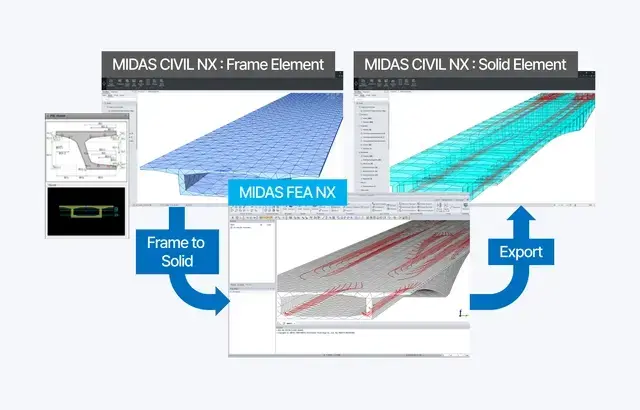
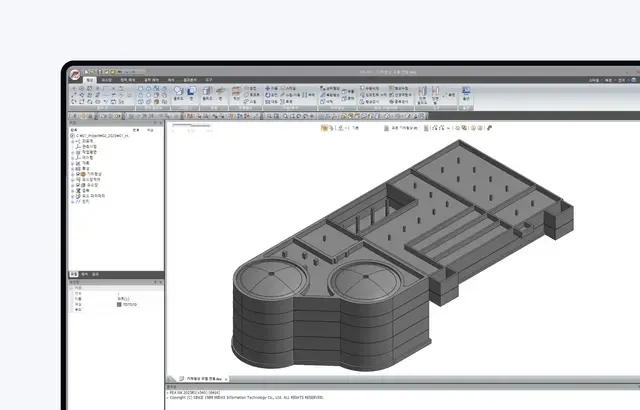
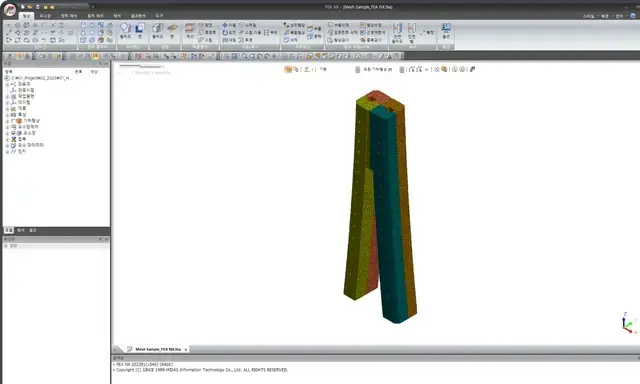
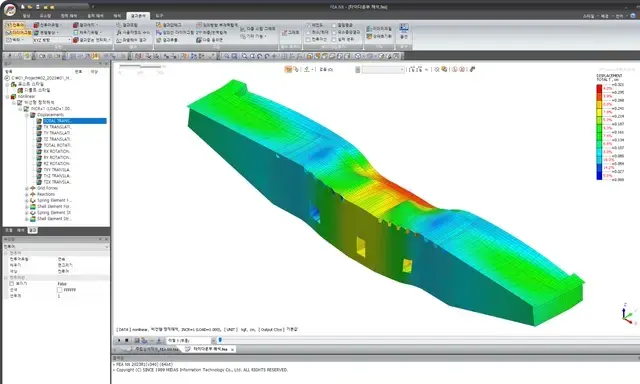
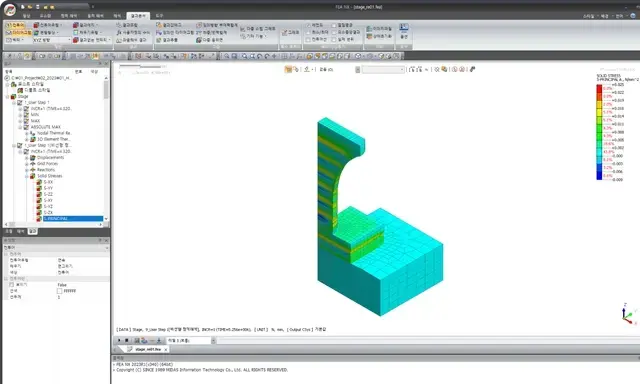
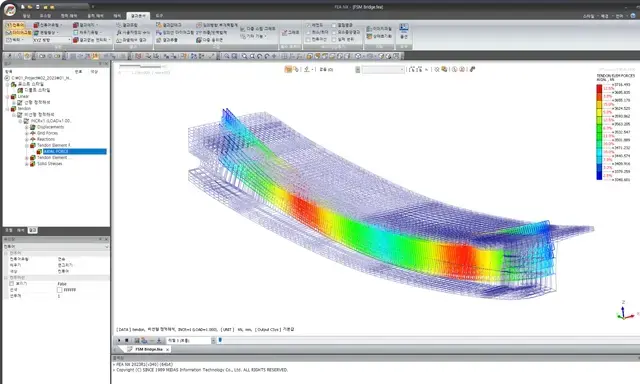
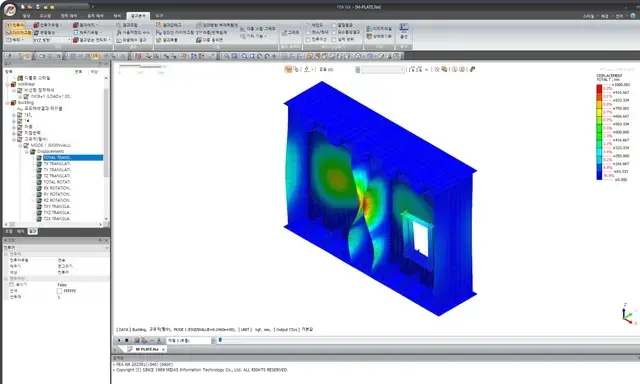
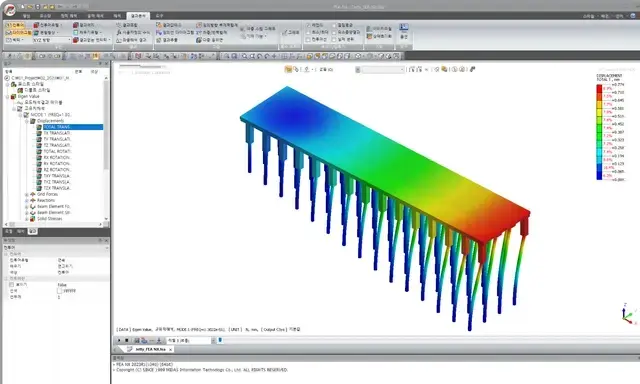
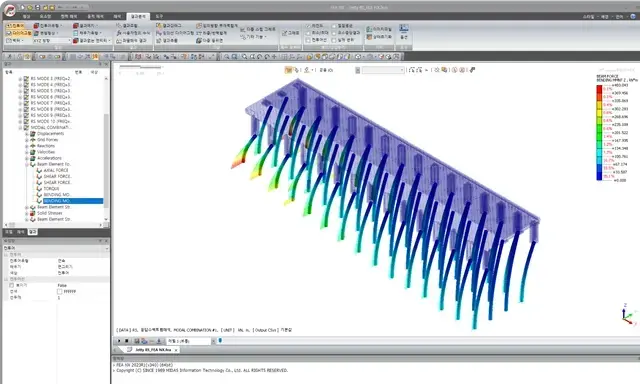
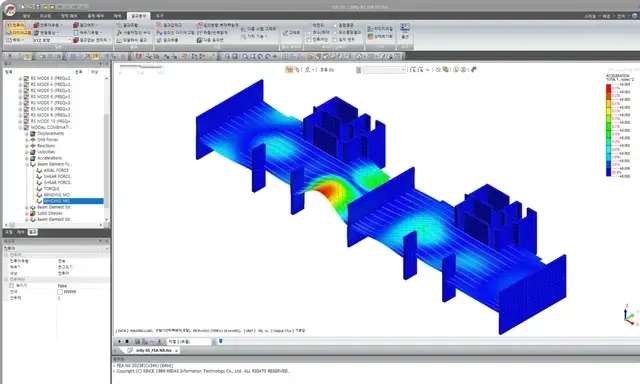
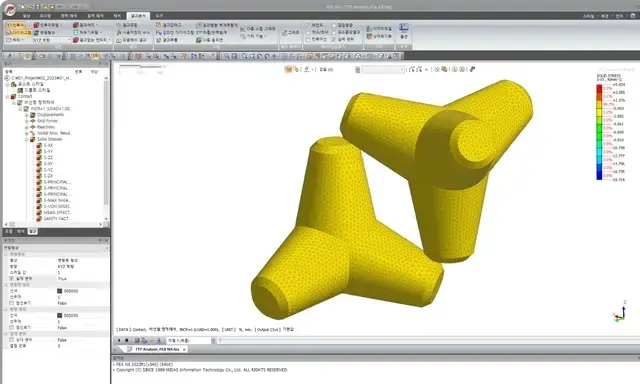
MIDAS FEA NX, based on 64-bit high-performance computing technology, applies a new framework that utilizes parallel processing based on MultiCore, EM64T, GPU, and co-processor, allowing the generation of meshes regardless of the number of elements, significantly reducing generation time. In addition, while triangular and quadrilateral elements are sufficient to create high-quality meshes for standardized and simple models, real-world structures often have complex and non-standard shapes. Therefore, the creation of hybrid meshes using both triangular and quadrilateral elements is necessary. FEA NX allows the creation of hybrid meshes using hexahedral, pyramid, tetrahedral, and prism elements, enabling the generation of high-quality meshes for models of any shape.
Various Advanced Analyses
Linear Static Analysis
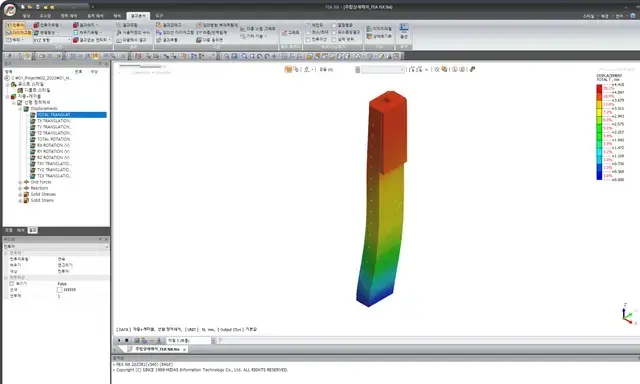
Linear static analysis is the fundamental analysis, evaluating the deformation and strength stability of structures under the action of external loads according to Hooke's law. It serves as the basis for all structural safety assessments. FEA NX provides the necessary material properties, loads, boundary conditions, and more for performing linear static analysis.
Material/Geometric Nonlinear Analysis
Linear elastic theory cannot be used to assess the deformation beyond the material's yield point and the ultimate load at failure. Therefore, nonlinear analysis that considers material nonlinearity is essential to evaluate structural behavior under extreme conditions. FEA NX can implement various nonlinear material properties for concrete and steel and perform detailed nonlinear analysis considering both material and geometric nonlinearity simultaneously.
Construction Stage Analysis
Concrete materials exhibit time-dependent strength development, and the loads applied during construction vary. Therefore, construction stage analysis that considers the time-dependent properties of concrete is necessary. FEA NX offers construction stage analysis, allowing simulation of multiple construction stages to find the optimal sequence that minimizes stress development and ensures stability while reducing construction costs.
Reinforcement/Tendon Analysis
Reinforcement and post-tensioned tendons, commonly used in economic structural designs, are challenging to model in finite element analysis. Analyzing structures with these components often requires a significant amount of time. FEA NX simplifies the modeling of reinforcement and tendons as embedded components, enabling immediate and long-term loss assessments, including friction, anchorage, relaxation, and creep/shrinkage effects.
Buckling Analysis
Buckling analysis evaluates the critical load at which a structure becomes unstable under compressive forces, helping determine deformation patterns and deformation shapes. FEA NX provides buckling analysis capabilities, making it easier to perform detailed designs of compressed structural components like columns, beams, and struts.
Eigenvalue Analysis
Eigenvalue analysis is crucial for understanding a structure's dynamic properties. It allows you to determine natural frequencies, mode shapes, and modal participation factors, which are essential for dynamic response analysis. FEA NX provides eigenvalue analysis capabilities, allowing you to examine vibration modes for structures and evaluate multiple mode shapes, including the fundamental mode.
Response Spectrum Analysis
Response spectrum analysis is a seismic design technique used to determine the maximum response of a structure to ground motion. FEA NX provides various response spectrum options based on international design codes, allowing for seismic analysis of structures according to specific requirements.
IBC2000 (ASCE7-98): United States, International Building Code 2000
UBC (1997): United States, Uniform Building Code 1997
EURO (2004H-ELASTIC): Europe, Seismic Design Provisions for Structures
Korea (Bridge): South Korea, Road Bridge Design Standards
Japan (Bridge02): Japan, Building Load Specifications and Dynamic Analysis
China (JTJ004-89): China, Seismic Design Specification for Highway Engineering
KBC 2009: South Korea, Building Structural Design Standards (2009), KBC 2005: South Korea, Building Structural Design Standards (2005)
Linear/Nonlinear Time History Analysis
Time history analysis is used to calculate the structural behavior (displacement, member forces, etc.) at arbitrary times using the dynamic properties of the structure and applied dynamic loads. MIDAS FEA NX provides both mode superposition and direct integration methods for time history analysis, allowing users to set damping conditions specific to each analysis method. Additionally, users can define their time function graphs for generating time history loads, and a database of commonly used time history loads is provided for convenient and efficient time history analysis during the design process.
Contact Analysis
Contact analysis involves examining the behavior associated with contact, such as frictional forces, stress, and deformation, that occurs on the surfaces of adjacent bodies, such as bolts. In FEA NX, various contact types are provided, including welded contact, general contact, two-way sliding contact, rough contact, and breaking-weld contact, all without the need for shared nodes between finite element models. Furthermore, automatic contact detection capabilities are available, allowing users to automatically identify contact surfaces where selected meshes meet, making contact analysis more convenient and efficient.
Interface Nonlinear Analysis
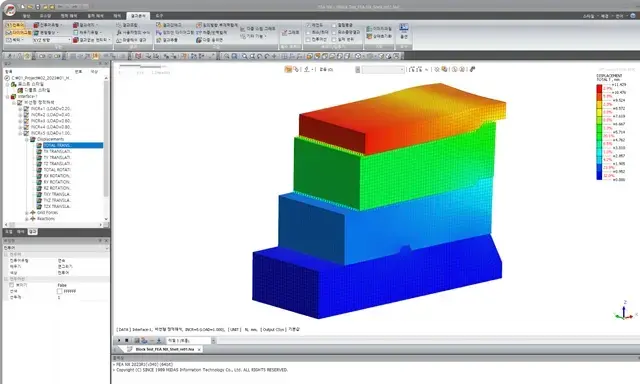
Various methods exist for dealing with the contact between different materials, especially at interfaces with dissimilar materials. In MIDAS FEA NX, there are five models available for defining the non-linear behavior of interfaces between dissimilar materials. These models include Discrete Cracking, Dilatancy Crack, Bond-Slip, Columb Friction, and a Combined Crack-Shearing-Crushing model. By applying the appropriate interface model based on the characteristics of the contact, users can assess stress and deformation at the structural interface, providing a comprehensive approach for analyzing the behavior of structures in contact with dissimilar materials.
Concrete Crack Analysis
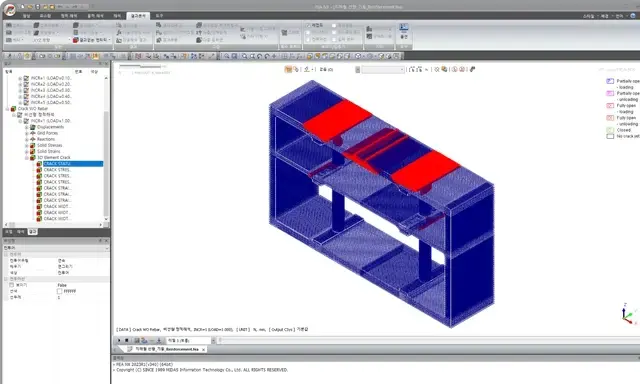
Concrete structures can develop cracks on their surfaces due to various conditions, and these cracks can significantly reduce the durability of the structure. Therefore, finite element analysis is necessary to assess cracks. In MIDAS FEA NX, the Smeared Crack model is provided to define the non-linear behavior for concrete crack analysis. With the crack analysis feature in MIDAS FEA NX, you can determine whether cracks will occur, their size, and the direction of propagation. Also, you can obtain the expected crack width.
Heat of Hydration Analysis
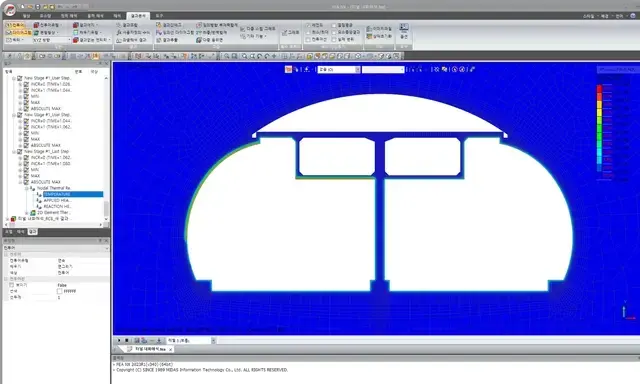
Mass concrete structures experience significant temperature changes and gradients due to the heat of hydration during curing. Analyzing the temperature distribution helps understand structural responses, deformations, and stresses. MIDAS FEA NX performs nonlinear analyses considering time-dependent material properties and thermal effects, facilitating accurate and efficient analysis of structures exposed to high temperatures.
Heat Transfer Analysis
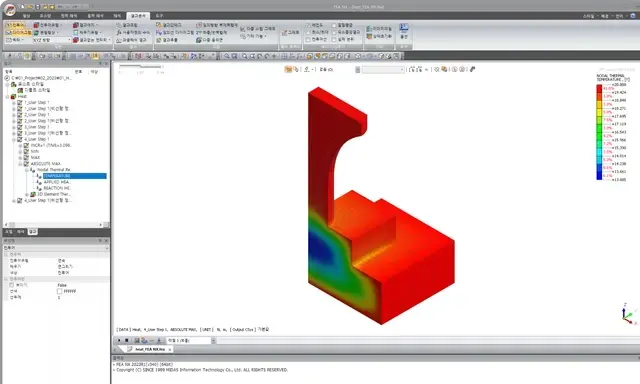
Structures exposed to high temperatures can undergo significant temperature changes and gradients over time. To understand the heat transfer characteristics of these structures and identify structural responses (deformation, stress) caused by temperature changes, heat transfer analysis is essential. In MIDAS FEA NX, nonlinear heat transfer analysis can be performed taking into account the changes of material properties, i.e. stiffness, specific heat, and thermal conductivity due to temperature to determine the temperature distribution with time and heat transfer characteristics of structures exposed to high temperatures.
Fatigue Analysis
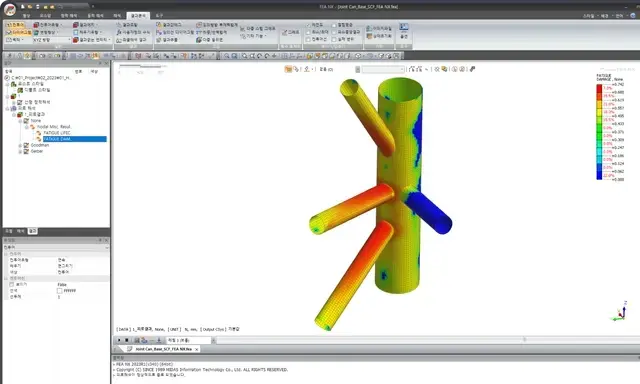
Steel structures subjected to repeated loading may experience fatigue failure. MIDAS FEA NX includes stress-life (S-N) and strain-life (E-N) fatigue analysis methods to evaluate the fatigue life and damage level of structures under variable loading conditions.